If you already ski well, you might think a ski simulator is just for beginners. It isn’t. For experienced skiers who live far from the mountains, ski simulator training is one of the easiest ways to stay sharp between trips and arrive ready to ski on day one.
Here’s what ski simulator training actually is, what it’s good for, and what it can’t replace.
What is a ski simulator?
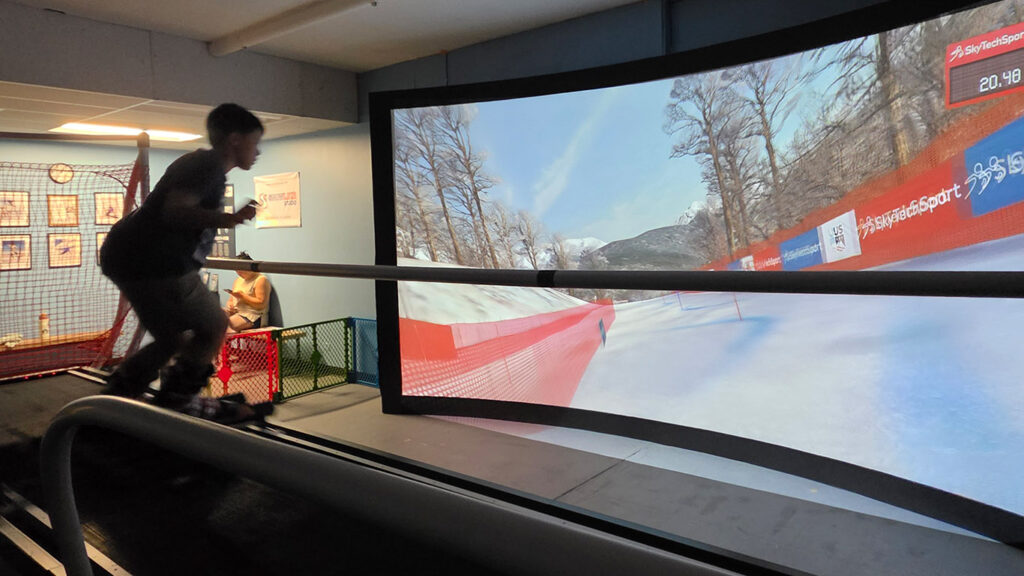
A ski simulator is a moving training surface that you ski on with real skis and real boots. On our advanced ski simulator, you face a large screen with a mountain run, and the surface moves under you while you make turns. You use the same movements you use on snow: balancing, tipping your skis onto their edges, and moving your weight from turn to turn.
What experienced skiers use it for
- Warming up before a trip. A few sessions wake up the muscles and timing you haven’t used since last season.
- Working on technique. Body position, edge angles, pressure on the outside ski and upper body stability are all easier to work on when you can repeat the same turn over and over.
- Fixing old habits. Many skiers learned on older, straighter skis and still ski that way. Modern skis turn more easily, and the simulator is a good place to adjust.
- Staying in ski shape. Continuous skiing builds the leg endurance that dry-land exercises don’t fully copy.
What a session looks like
- You put on boots and skis. You can bring your own boots and helmet if you have them.
- The simulator is set to match your level.
- You ski in short blocks with rests in between, because continuous skiing is more intense than most people expect.
- Between blocks, you think about one thing to change, then try it on the next run.
Independent training sessions don’t include an instructor, but a simulator operator is present the whole time. If you’d like coaching, book a private lesson and an instructor will work with you on specific goals.
Is it the same as skiing on snow?
Not exactly, and it doesn’t need to be. On snow, you deal with changing terrain, conditions and crowds. On a simulator, the surface is predictable. That’s actually the point: you can focus on your movement without distractions, and get far more turns in an hour than you would on the mountain, where much of the time is spent on lifts.
What the simulator won’t do is teach you to read moguls, powder or ice. But it gives you a stronger, more consistent base for all of those.
How many sessions do experienced skiers need?
It depends on your goal:
- Trip warm-up: 2 to 4 sessions in the last few weeks before you leave.
- Technique project: a lesson package over 4 to 8 weeks, so you have time to practice between sessions.
- Year-round training: regular sessions every week or two.
See current options on Pricing & Booking. Packages are valid for 3 months.
Ski simulator vs. dry-land training
Dry-land exercises like squats, lunges and balance work build strength. They’re a great base, and we recommend them. But they don’t train the exact movement of skiing: tipping your skis, moving from edge to edge and staying balanced over a moving surface. A ski simulator does. The best preparation combines both: a few weeks of exercises for strength, plus a few simulator sessions for timing and technique. Read more in How to Get in Ski Shape Before Ski Season.
Frequently asked questions
Is a ski simulator good for advanced skiers?
Yes. Advanced skiers use it to refine carving, edge control and body position, and to stay in ski shape between trips.
Do I need my own equipment?
No. All equipment is provided at no extra cost. You can bring your own boots and helmet.
Is it hard?
It’s more intense than most people expect, because you ski continuously. Short rests between runs are normal.
Who it’s for
- Recreational skiers who ski one or two trips a year
- Skiers returning after a break of several years
- Parents who want to keep up with their kids
- Skiers who want cleaner, more confident carving
- Snowboarders too: we also offer snowboard training
Try ski simulator training near Chicago
Snowlike Studio is in Schaumburg, IL, in Chicago’s northwest suburbs. All sessions are by appointment. Arrive 5 minutes early to sign the waiver, and wear long ski socks and athletic clothing.